Search News
Industry Portal
Popular Tags
Are Automated Guided Vehicles Safe Around Container Traffic?
Author
Time
Click Count
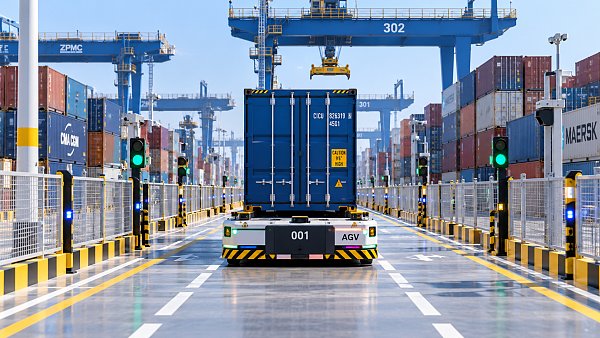
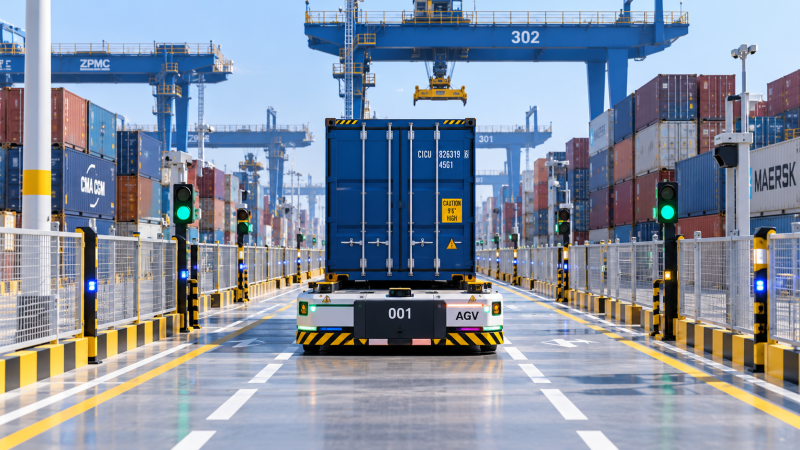
Automated guided vehicles can operate safely around container traffic, but only when safety is designed as a terminal-wide control system rather than treated as a feature of the vehicle itself. A container yard combines heavy moving equipment, blind spots created by stacks, changing work zones, uneven pavement, poor weather, truck queues, and crane interfaces. In that setting, an AGV’s sensors are necessary but not sufficient.
The decisive question is whether the terminal can maintain a controlled operating environment: defined vehicle routes, known right-of-way rules, reliable position data, protected interfaces with manned equipment, and a conservative response when the automation loses confidence. Where those conditions are absent, an AGV may still move containers efficiently in isolated areas, but it should not be assumed to coexist safely with unrestricted truck, reach stacker, straddle carrier, or pedestrian traffic.
Container terminals are not ordinary AGV environments
An AGV working in a warehouse usually shares space with relatively low-speed forklifts, pedestrians, racking, and floor-level loads. A container terminal introduces a different risk profile. The vehicle may carry a loaded container, travel over long outdoor routes, pass beneath quay cranes or automated stacking cranes, and interact with equipment whose mass, braking distance, and turning envelope are far greater than those of indoor industrial vehicles.
Container stacks create visual occlusion and can degrade the usefulness of a sensor-only safety approach. A truck may enter a crossing area from behind a stack. A straddle carrier may obstruct a camera or LiDAR field. Rain, sea spray, dust, glare, fog, and standing water can affect perception quality or lane-marking visibility. Global Navigation Satellite System positioning can also become less dependable near large steel structures, cranes, stacked containers, and buildings. The safety system therefore cannot rely on one location method or one perception technology.
The most difficult interactions occur at transition points: gates, truck transfer lanes, quay crane work zones, stack interfaces, maintenance crossings, and areas where manual recovery operations take place. These are locations where an AGV’s planned route meets people, road vehicles, or machines that may not follow the automation system’s assumptions.
In practical terms, the question “Do automated guided vehicles work safely around container traffic?” should be answered by examining the operating domain. An AGV can be safe within a tightly controlled domain; it is not automatically safe in every part of an active port or intermodal yard.
Segregation is usually more important than obstacle avoidance
A common misunderstanding is that advanced obstacle detection makes physical or operational separation unnecessary. In container operations, obstacle detection is a last line of protection, not the main traffic-management method.
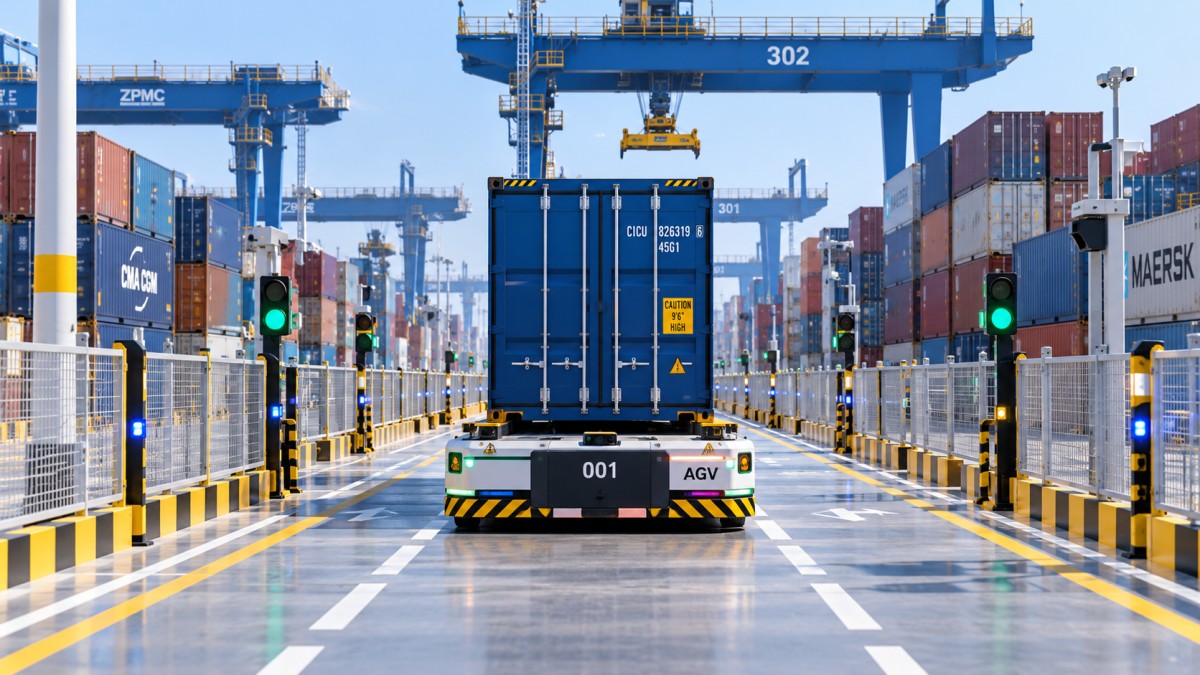
The stronger design is to separate automated and conventional traffic wherever the process allows. This can include dedicated AGV lanes, fenced or geofenced operating areas, controlled crossings, one-way travel paths, designated truck handover points, and access-controlled crane work zones. Segregation reduces the number of unpredictable interactions that the AGV must interpret in real time.
Where mixed traffic cannot be avoided, the interface needs explicit rules. A human truck driver must know whether an AGV will yield, stop, proceed under signal control, or wait for a clearance command. A straddle carrier operator needs enough warning and visibility to understand that an unmanned vehicle may be entering a shared zone. Relying on informal local driving habits creates ambiguity precisely where automated equipment needs predictable behavior.
Controlled crossings are particularly important. The system should identify the crossing as a distinct safety zone, prevent conflicting movement permissions, and account for the time required for each vehicle type to clear the zone. A simple “vehicle detected” logic is weaker than a zone-reservation approach that prevents an AGV and a manned vehicle from being authorized to occupy the same conflict area.
Segregation also applies vertically and operationally. Under crane structures, the movement authority of the AGV, crane trolley, spreader, and any personnel entering the area must be coordinated. A vehicle path may be clear at ground level while overhead lifting operations or container-handling sequences make movement unsafe.
Safe movement depends on predictable stopping behavior
An AGV must be able to stop before reaching a person, vehicle, barrier, or restricted zone. That sounds elementary, but the stopping calculation in a container terminal is not fixed. It changes with payload, speed, tire condition, pavement friction, gradient, rain, turning, battery state, control-system delay, and the braking characteristics of the vehicle.
Safety zones generated by LiDAR or similar scanners should not be treated as static geometric fields. At higher speed, the protective field must extend farther ahead. With a loaded container, the system may require a larger margin than when the vehicle is empty. If the pavement becomes wet or contaminated, the permitted speed and braking assumptions may need to change. A terminal that uses the same stopping configuration in all weather and load conditions risks converting a conservative design assumption into an unsafe one.
There is also a distinction between controlled stopping and emergency stopping. A controlled stop may be used when the AGV receives an instruction to wait, approaches a blocked zone, or detects a noncritical route conflict. An emergency stop is intended for an immediate hazard or failure condition. Both functions need clear logic because excessive emergency stops can create their own operational danger: a stopped AGV may block a travel lane, disrupt crane cycles, or leave a container in a location that prevents safe recovery.
Safe automation does not mean that every uncertain object is ignored until it becomes an emergency. It means uncertainty triggers an appropriate reduction in speed, a hold position, a request for clearance, or a transfer to a supervised recovery procedure before the vehicle reaches a hazardous state.
Sensor redundancy must be matched to the actual hazards
Container AGVs commonly combine several technologies: LiDAR for obstacle detection and local mapping, cameras for classification and supervision, radar for robust detection in difficult visibility, encoders and inertial measurement for vehicle motion, and satellite-based positioning or infrastructure markers for route location. The value comes from how these systems are combined, not from the number of sensor types listed in a specification.
For example, LiDAR can provide accurate range information but may have limitations with certain reflective surfaces, heavy rain, spray, or occluded targets. Cameras can help distinguish a person from a container corner or roadside object, yet performance depends on lighting, lens condition, and image quality. Radar can support detection in conditions that challenge optical systems, but its resolution and object interpretation differ from camera or LiDAR outputs. A sensible design uses independent inputs to reduce the likelihood that a single environmental condition removes critical protection.
Positioning requires similar discipline. An AGV should not continue normal-speed operation merely because it has an approximate global position. It must know whether its location confidence is sufficient for the task being performed. The consequence of a small position error is very different in an open travel lane than when aligning beneath a crane, approaching a container handover point, or entering a narrow stack block.
Sensor health monitoring is therefore a safety function, not just a maintenance feature. The system should detect blocked lenses, scanner contamination, communication loss, abnormal localization drift, timing faults, and inconsistent sensor readings. When the required confidence level is lost, the defined response should be safe and operationally manageable: slow down, stop at a safe location, withdraw from a shared area if feasible, or request intervention.
Traffic control needs authority over every vehicle movement
In a high-density terminal, safe AGV operation relies on a fleet-management layer that understands more than each vehicle’s current position. It needs to manage route permissions, conflict zones, crane handovers, traffic priorities, blocked lanes, and exception states. The system should know not only where vehicles are, but also where they are authorized to be.
A route reservation model is generally stronger than a simple dispatch model. Under route reservation, the AGV receives movement authority for defined segments or zones. The system prevents incompatible reservations and releases the zone only after verifying that it has been cleared. This approach is useful around intersections, crane lanes, narrow corridors, and transfer points where two large vehicles cannot safely pass.
However, central traffic management should not be the only protection layer. Communications can be delayed or interrupted. The vehicle needs local safety functions capable of bringing it to a safe state if route authority becomes invalid, a communication link fails, or its onboard perception detects an unexpected obstacle. Fleet control manages traffic efficiency and planned separation; onboard safety systems protect against immediate hazards and failures.
Interfaces with manned vehicles require special attention. A terminal may use connected truck systems, gate appointment systems, traffic lights, lane displays, barriers, or mobile communications to reduce uncertainty. These tools can improve coordination, but they should not assume perfect driver compliance. A truck can stop in the wrong lane, reverse unexpectedly, or enter a restricted zone. The AGV must retain a conservative response to unauthorized entry.
Crane handovers create concentrated risk
The transfer of containers between AGVs and cranes is one of the most safety-critical parts of the workflow. The automated vehicle must arrive at the correct position, orientation, and timing. The crane must confirm that the AGV is in the designated handover state before lowering or lifting a container. Neither system should infer that condition merely from a scheduled task.
A robust handover sequence uses positive confirmation. The AGV reports that it has reached the correct position and entered a secure state; the crane or terminal control system verifies zone occupancy and alignment conditions; lifting or lowering is then permitted. If any required condition is missing, the load movement should be inhibited rather than relying on manual judgment under time pressure.
Personnel access around these interfaces needs equally clear control. Maintenance, lashing activity, inspection, spill response, and abnormal-load recovery can bring people into areas normally occupied only by automated vehicles. The terminal must have a formal method to suspend automated movement, isolate the zone, and confirm that movement authority cannot be restored until access is cleared. A warning beacon alone is not an access-control system.
Degraded modes reveal whether the safety concept is mature
Normal operation is rarely the best test of an AGV safety design. The more revealing question is what happens when something is abnormal: a container falls out of its planned position, a truck blocks a lane, a scanner becomes dirty, a crane is unavailable, pavement is flooded, communications fail, or a vehicle stops in a location that prevents other equipment from passing.
Every operating domain should define degraded modes in advance. These may include reduced-speed operation during poor visibility, temporary exclusion of areas with unreliable positioning, manual escort for recovery moves, suspension of mixed-traffic operation, or full shutdown of a zone after a safety-system fault. The correct choice depends on the hazard and the remaining protective functions. Continuing operation at normal productivity with reduced sensing or uncertain traffic control is not a valid fallback strategy.
Recovery deserves more planning than it often receives. An immobilized AGV carrying a container may require intervention by technicians, crane operators, terminal controllers, and nearby vehicle operators. Recovery procedures need designated approach routes, lockout or isolation controls, communication protocols, and clear authority to place the vehicle into a safe maintenance state. Improvised recovery can expose people to both vehicle movement and suspended-load hazards.
Compliance cannot be reduced to a certificate check
Depending on the vehicle design and jurisdiction, automated container-handling equipment may fall under machinery safety rules, workplace safety requirements, vehicle regulations, port authority rules, and national technical standards. The applicable obligations should be determined for the actual terminal, equipment type, and operating mode rather than assumed from a supplier’s general compliance statement.
ISO 3691-4 provides widely referenced safety requirements and verification concepts for driverless industrial trucks and their systems. Its relevance should be assessed carefully where equipment is purpose-built for container-terminal service rather than conventional industrial-truck use. Functional-safety methods associated with standards such as ISO 13849 or IEC 61508 may also inform the design of safety-related controls, but the appropriate framework depends on the architecture and regulatory context.
Certificates and declarations are useful evidence, yet they do not validate a specific traffic layout, local pavement condition, crane interface, emergency process, or mixed-traffic arrangement. Site acceptance testing must examine the installed system under the operational conditions it is expected to manage. That includes detection boundaries, stopping performance, route conflicts, communication loss, unauthorized entry, sensor degradation, and emergency access procedures.
The safer decision is often to limit the first operating domain
Container AGVs are most defensible when introduced into routes and tasks that can be controlled with high confidence. A dedicated quay-crane-to-yard route, a protected transfer lane, or an automated stack block may be a suitable starting point. Public-road-like truck circulation, informal shortcut routes, unrestricted pedestrian access, and densely mixed equipment zones demand a much higher level of control and may not be suitable for the same operating logic.
Safety around container traffic is therefore not a binary property of automated guided vehicles. It is the outcome of route design, physical separation, dynamic speed control, redundant sensing, verified crane handovers, traffic authority, disciplined recovery procedures, and site-specific validation. When those elements work together, AGVs can remove people from routine exposure to heavy container movement. When they do not, automation can make an already complex traffic environment harder to understand and more difficult to control.
Recommended News
 Oct 02, 2026Are Automated Guided Vehicles Safe Around Container Traffic?Do automated guided vehicles work safely around container traffic? Discover how segregation, sensor redundancy, traffic control, and crane handovers protect terminal operations.
 Oct 01, 2026How Can Fleet Management Systems Reduce Unplanned Forklift Downtime?How can fleet management systems reduce unplanned forklift downtime? Explore telematics, predictive maintenance, battery monitoring, and utilization insights to improve uptime and cut costs.
 Sep 27, 2026When does a distribution center need an automated storage system?Automated storage and retrieval systems distribution center guide: identify capacity, labor, and accuracy triggers, compare options, and build a stronger ROI case.
 Sep 17, 2026How extreme moment balance affects crane stability under offset loadsExtreme moment-balance mechanics stability is crucial for crane lifts under offset loads. Learn how to assess tipping risk, dynamic forces, and safer lift planning.
 Sep 09, 2026When warehouse vehicle telematics pays off in high-density operationsWarehouse vehicle telematics helps high-density operations reduce downtime, optimize fleet use, manage batteries, and improve safety. See when the investment delivers ROI.
 Sep 05, 2026When does ultra-fast handling logistics justify warehouse automation?Ultra-fast handling logistics: discover when warehouse automation improves capacity, reliability, safety, and ROI—and when smarter manual upgrades are the better choice.
 Aug 24, 2026What limits industrial lifting efficiency in overhead crane systemsIndustrial lifting efficiency in overhead crane systems depends on sway control, duty cycle, layout, and maintenance. Discover what really limits throughput and how to improve safer, faster handling.
 Aug 15, 2026How to choose a hydraulic mast systems manufacturer for heavy-duty useHydraulic mast systems manufacturer guide for heavy-duty use: learn how to compare engineering strength, safety, service, and long-term value before you choose.
 Aug 14, 2026How to Evaluate a Warehouse Automation Solutions Supplier for Integration, Uptime, and ScalabilityWarehouse automation solutions supplier evaluation guide: learn how to assess integration, uptime, and scalability to reduce risk and choose a supplier that supports long-term growth.
 Aug 05, 2026How to Improve Factory Material Flow Without Expanding Floor SpaceFactory material flow improvements do not always need more space. Learn practical ways to cut travel, reduce handling, improve safety, and boost output within your current plant layout.
 Jul 22, 2026How Smart Material Handling Systems Improve Factory ThroughputSmart material handling systems for factories boost throughput by reducing delays, improving safety, and matching automation to real bottlenecks. See how to choose the right fit.
 Jul 14, 2026Warehouse Vehicle Monitoring: Key Data Points That Prevent DowntimeWarehouse vehicle monitoring helps prevent downtime by tracking battery health, utilization, impacts, fault codes, and operator behavior—giving managers actionable insights to improve uptime and fleet efficiency.
 Jul 14, 2026How to Choose Warehouse Automation Solutions for PalletsWarehouse automation solutions for pallets: learn how to evaluate pallet flow, layout, software integration, safety, and ROI to choose a smarter, scalable warehouse system.
 Jul 13, 2026Smart Warehouse Trends: What Is Changing in 2026?Smart warehouse trends in 2026 are shifting from isolated automation to connected, measurable performance. Discover safer, smarter ways to boost throughput, uptime, and ROI.
 Jul 12, 2026ASRS Warehouse Design: When Higher Density Starts to Hurt ThroughputASRS warehouse design should maximize flow, not just storage density. Learn when higher density cuts throughput and how to protect ROI, speed, and service levels.
 Jul 11, 2026How Synchronized Hydraulic Lifting Systems Improve Load Control on Heavy LiftsSynchronized hydraulic lifting systems improve load control on heavy lifts with real-time balancing, better structural protection, and safer multi-point lifting performance.
 Jul 10, 2026Automated Warehousing Integration: What Fails First on SiteAutomated warehousing integration often fails first at transfer zones, interfaces, and data timing. Discover the on-site risks that delay go-live—and how to prevent them.
 Jul 09, 2026When Heavy Load Automation Delivers Better Throughput Than Manual HandlingHeavy load automation boosts throughput by reducing cycle variation, safety risk, and delays. See when it outperforms manual handling in real operations.
 Jul 07, 2026AGV Material Handling Systems for Busy Warehouses: What Improves ThroughputAGV material handling systems help busy warehouses boost throughput by reducing travel waste, stabilizing cycle times, and improving peak flow. Discover what drives measurable gains.
 Jul 04, 2026Heavy Component Transport Systems for Steel Mills: Key Design FactorsHeavy component transport systems for steel mills demand smart design. Learn key factors for load handling, route safety, heat resistance, and uptime to improve mill efficiency.
 Jul 03, 2026Automated Warehouse Systems for Cold Storage: Key Design FactorsAutomated warehouse systems cold storage design depends on temperature, SKU flow, compliance, and uptime. Learn the key factors to build safer, more efficient cold storage automation.
 Jul 02, 2026Chain Hoist Systems Electric: Key Load, Duty Cycle, and Control ChoicesChain hoist systems electric selection goes beyond rated capacity. Learn how load, duty cycle, controls, and safety features affect uptime, precision, and long-term value.
 Jul 01, 2026Millimetre Precision Load Control in Crane OperationsMillimetre precision load control improves crane safety, reduces sway, and boosts placement accuracy. Discover how smart drives and anti-sway systems raise uptime and efficiency.
 Jun 30, 2026Warehouse Control Systems vs WMS: What Actually Improves Throughput?Warehouse control systems vs WMS: discover which one improves throughput faster, where each fits, and how to identify the real bottleneck before investing.