Search News
Industry Portal
Popular Tags
Millimetre Precision Load Control in Crane Operations
Author
Time
Click Count
Millimetre Precision Load Control in Crane Operations
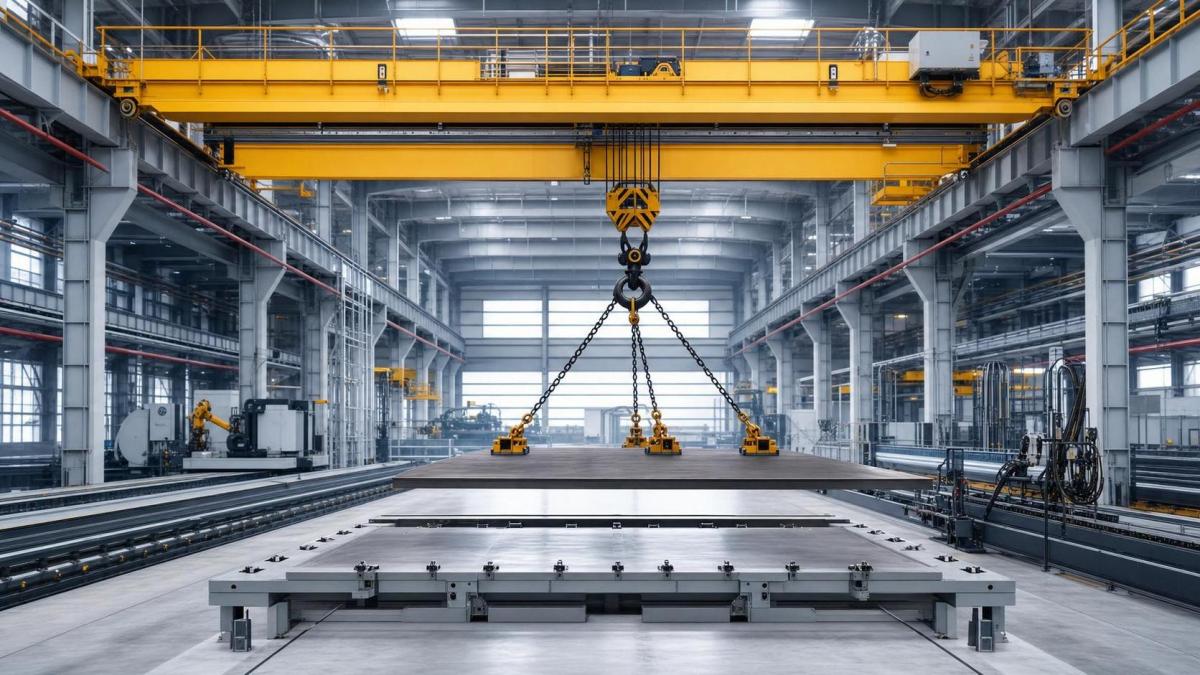
In crane operations, millimetre precision load control has moved from a premium option to a working requirement.
The reason is simple. Modern sites run faster, loads are more expensive, and tolerance windows are much tighter than before.
In steel plants, ports, fabrication workshops, and automated warehouses, poor positioning accuracy creates risk long before it creates visible damage.
A few uncontrolled millimetres can mean collision, load swing, fixture impact, or a delayed cycle that repeats all day.
That is why millimetre precision load control now shapes buying decisions for overhead cranes, gantry cranes, hoists, and smart lifting systems.
From a practical standpoint, the question is not whether precision matters. The real question is how a crane achieves it consistently.
The answer usually sits in the interaction between drive control, anti-sway logic, operator interface, structure stiffness, and feedback quality.
When these elements are tuned together, millimetre precision load control becomes repeatable in real production, not just in demonstrations.
Why Precision Control Matters More Now
Recent operating trends have changed crane evaluation criteria.
Loads are larger, but landing zones are often smaller. Production lines also expect higher throughput without adding risk.
This makes millimetre precision load control important in several ways.
- It reduces swing before final placement.
- It shortens settling time at the destination.
- It lowers contact damage to molds, tools, racks, and structures.
- It improves operator confidence during repetitive cycles.
- It supports automated or semi-automated handoff processes.
In actual operations, precision also influences maintenance cost.
A crane that overshoots, brakes harshly, or allows repeated load impact will wear wheels, rails, brakes, wire rope, and structures faster.
So millimetre precision load control is not only about exact placement. It is also about lifecycle stability and predictable uptime.
What Enables Millimetre Precision Load Control
Many buyers focus on rated capacity first. That is necessary, but it tells very little about real control quality.
Millimetre precision load control usually depends on five technical layers working together.
1. Closed-loop drive response
A VFD alone does not guarantee fine control. The key is how quickly and smoothly the system responds to speed and torque changes.
Closed-loop control with encoder feedback helps maintain accurate motion during acceleration, creep travel, and stopping.
2. Anti-sway logic
Millimetre precision load control becomes much harder when the suspended load behaves like a pendulum.
Anti-sway systems calculate corrective motion to minimize oscillation during trolley travel, bridge travel, and combined movements.
Better systems also adapt to rope length, load weight, and operating speed.
3. High-quality feedback signals
Precise lifting depends on accurate information. Encoders, load cells, position sensors, and limit references all affect command quality.
If the feedback is noisy or delayed, millimetre precision load control becomes unstable.
4. Mechanical rigidity
Control software cannot fully compensate for a flexible structure, misaligned rail, worn wheel, or poor gearbox condition.
Mechanical quality sets the baseline for repeatable positioning accuracy.
5. Operator interface design
Even advanced automation can be undermined by poor control feel.
Proportional joysticks, speed zoning, micro-motion modes, and clear feedback screens make millimetre precision load control easier to achieve in daily work.
Typical Application Scenarios
Not every crane application needs the same level of precision. The strongest demand appears where load placement directly affects process continuity.
Across these cases, the common need is stable placement without long correction time.
That is where millimetre precision load control delivers a clear operating advantage.
How to Evaluate Solutions Without Guesswork
Many crane proposals mention smooth motion and intelligent control. Those phrases are too general to support a decision.
A better approach is to evaluate millimetre precision load control through specific performance questions.
- What positioning accuracy is proven under rated load, partial load, and different rope lengths?
- How long does the load need to settle after bridge or trolley motion stops?
- Does the anti-sway function work automatically, or does it depend on operator skill?
- What sensors and feedback loops support the control model?
- Can the crane keep millimetre precision load control during diagonal movement and repeated cycles?
- How does the system perform when rails, floor conditions, or wind create disturbance?
- What commissioning effort is needed to tune the crane for site conditions?
It also helps to request site references with similar duty cycles, similar load geometry, and similar operator experience levels.
Lab performance is useful, but field stability is what proves the value of millimetre precision load control.
Common Risks That Reduce Precision
Even strong hardware can lose accuracy when key risks are ignored.
- Overly aggressive acceleration settings that create unnecessary sway
- Weak structural stiffness in long-span crane systems
- Inconsistent rope behavior under changing hook heights
- Poor rail alignment that introduces side forces and vibration
- Insufficient operator training for creep positioning
- Lack of maintenance on brakes, wheels, and encoder assemblies
These issues often appear as a control problem, but the root cause may be mechanical or operational.
That is why millimetre precision load control should always be assessed as a full system capability.
A Practical Selection Framework
When comparing crane suppliers, a simple framework keeps the decision grounded.
Start with the process, not the brochure.
- Define the placement tolerance that the production step really needs.
- Map the load shape, center of gravity, hook travel, and cycle frequency.
- Identify environmental disturbances such as wind, heat, dust, or uneven rails.
- Check whether millimetre precision load control is manual, assisted, or fully automated.
- Compare commissioning support, diagnostics, and long-term service capability.
This method usually reveals whether a supplier understands the application or is only describing general crane features.
A credible solution provider should explain how millimetre precision load control is maintained over time, not only at handover.
Final Takeaway
Millimetre precision load control is now a serious benchmark for crane performance in industrial lifting.
It improves safety, protects assets, supports faster cycles, and creates more predictable operating results.
The strongest solutions combine closed-loop drives, adaptive anti-sway control, reliable feedback, mechanical integrity, and usable interfaces.
For any crane project facing tight tolerances or high-value loads, millimetre precision load control should be verified through real application conditions.
That approach leads to better supplier comparison, clearer risk judgment, and a lifting system that performs where it actually matters.
Recommended News
 Sep 09, 2026When warehouse vehicle telematics pays off in high-density operationsWarehouse vehicle telematics helps high-density operations reduce downtime, optimize fleet use, manage batteries, and improve safety. See when the investment delivers ROI.
 Sep 05, 2026When does ultra-fast handling logistics justify warehouse automation?Ultra-fast handling logistics: discover when warehouse automation improves capacity, reliability, safety, and ROI—and when smarter manual upgrades are the better choice.
 Aug 24, 2026What limits industrial lifting efficiency in overhead crane systemsIndustrial lifting efficiency in overhead crane systems depends on sway control, duty cycle, layout, and maintenance. Discover what really limits throughput and how to improve safer, faster handling.
 Aug 15, 2026How to choose a hydraulic mast systems manufacturer for heavy-duty useHydraulic mast systems manufacturer guide for heavy-duty use: learn how to compare engineering strength, safety, service, and long-term value before you choose.
 Aug 14, 2026How to Evaluate a Warehouse Automation Solutions Supplier for Integration, Uptime, and ScalabilityWarehouse automation solutions supplier evaluation guide: learn how to assess integration, uptime, and scalability to reduce risk and choose a supplier that supports long-term growth.
 Aug 05, 2026How to Improve Factory Material Flow Without Expanding Floor SpaceFactory material flow improvements do not always need more space. Learn practical ways to cut travel, reduce handling, improve safety, and boost output within your current plant layout.
 Jul 22, 2026How Smart Material Handling Systems Improve Factory ThroughputSmart material handling systems for factories boost throughput by reducing delays, improving safety, and matching automation to real bottlenecks. See how to choose the right fit.
 Jul 14, 2026Warehouse Vehicle Monitoring: Key Data Points That Prevent DowntimeWarehouse vehicle monitoring helps prevent downtime by tracking battery health, utilization, impacts, fault codes, and operator behavior—giving managers actionable insights to improve uptime and fleet efficiency.
 Jul 14, 2026How to Choose Warehouse Automation Solutions for PalletsWarehouse automation solutions for pallets: learn how to evaluate pallet flow, layout, software integration, safety, and ROI to choose a smarter, scalable warehouse system.
 Jul 13, 2026Smart Warehouse Trends: What Is Changing in 2026?Smart warehouse trends in 2026 are shifting from isolated automation to connected, measurable performance. Discover safer, smarter ways to boost throughput, uptime, and ROI.
 Jul 12, 2026ASRS Warehouse Design: When Higher Density Starts to Hurt ThroughputASRS warehouse design should maximize flow, not just storage density. Learn when higher density cuts throughput and how to protect ROI, speed, and service levels.
 Jul 11, 2026How Synchronized Hydraulic Lifting Systems Improve Load Control on Heavy LiftsSynchronized hydraulic lifting systems improve load control on heavy lifts with real-time balancing, better structural protection, and safer multi-point lifting performance.
 Jul 10, 2026Automated Warehousing Integration: What Fails First on SiteAutomated warehousing integration often fails first at transfer zones, interfaces, and data timing. Discover the on-site risks that delay go-live—and how to prevent them.
 Jul 09, 2026When Heavy Load Automation Delivers Better Throughput Than Manual HandlingHeavy load automation boosts throughput by reducing cycle variation, safety risk, and delays. See when it outperforms manual handling in real operations.
 Jul 07, 2026AGV Material Handling Systems for Busy Warehouses: What Improves ThroughputAGV material handling systems help busy warehouses boost throughput by reducing travel waste, stabilizing cycle times, and improving peak flow. Discover what drives measurable gains.
 Jul 04, 2026Heavy Component Transport Systems for Steel Mills: Key Design FactorsHeavy component transport systems for steel mills demand smart design. Learn key factors for load handling, route safety, heat resistance, and uptime to improve mill efficiency.
 Jul 03, 2026Automated Warehouse Systems for Cold Storage: Key Design FactorsAutomated warehouse systems cold storage design depends on temperature, SKU flow, compliance, and uptime. Learn the key factors to build safer, more efficient cold storage automation.
 Jul 02, 2026Chain Hoist Systems Electric: Key Load, Duty Cycle, and Control ChoicesChain hoist systems electric selection goes beyond rated capacity. Learn how load, duty cycle, controls, and safety features affect uptime, precision, and long-term value.
 Jul 01, 2026Millimetre Precision Load Control in Crane OperationsMillimetre precision load control improves crane safety, reduces sway, and boosts placement accuracy. Discover how smart drives and anti-sway systems raise uptime and efficiency.
 Jun 30, 2026Warehouse Control Systems vs WMS: What Actually Improves Throughput?Warehouse control systems vs WMS: discover which one improves throughput faster, where each fits, and how to identify the real bottleneck before investing.
 Jun 30, 2026Automated Warehouse Systems Software: Key Features That MatterAutomated warehouse systems software: discover the key features that improve inventory accuracy, task orchestration, equipment integration, safety, and ROI before you choose a platform.
 Jun 28, 2026Automated Warehousing Systems: When Does Automation Pay Off?Automated warehousing systems pay off when they solve labor, space, and throughput bottlenecks. Learn the key ROI signals, hidden costs, and when automation truly adds value.
 Jun 26, 2026Hydraulic Lifting Jacks: How to Choose Capacity and Lift HeightHydraulic lifting jacks: learn how to choose the right capacity and lift height for safer, more efficient lifting. Compare key specs, clearance needs, and real-world selection tips.
 Jun 25, 2026Industrial Lifting Efficiency in Factories: What Really Improves OutputIndustrial lifting efficiency factory performance depends on equipment fit, stability, uptime, and safer flow. Discover what really boosts output and cuts hidden delays.