Search News
Industry Portal
Popular Tags
When Should an Overhead Crane Brake Be Replaced?
Author
Time
Click Count
When Should an Overhead Crane Brake Be Replaced?
When should an overhead crane brake be replaced? The practical answer is: before it can no longer hold, stop, or release the load in the way the crane was designed to operate. That sounds obvious, but brake decisions are rarely made on one symptom alone. A brake lining can still look usable while the crane develops excessive stopping distance. A recently adjusted brake may hold during an unloaded test yet drift with a suspended load. A coil may be electrically healthy but fail intermittently once heat, dust, vibration, or voltage drop enter the picture.
For maintenance teams, the goal is not to replace brakes at the first sign of normal wear. It is to recognize when adjustment is no longer a safe or economical answer. On overhead cranes, particularly hoists handling production-critical loads, brake condition affects more than downtime. It affects load control, hook positioning, gearbox stress, operator confidence, and the margin available when something else in the lifting system is not quite right.
This matters across workshops, steel service centers, warehouses, ports, fabrication plants, and maintenance bays. A lightly used crane in a clean assembly hall may age differently from a hoist in a foundry, shipyard, or outdoor gantry application. Duty cycle, load spectrum, ambient temperature, moisture, and the way operators use inching controls all change the replacement decision.
A brake is due for replacement when it no longer meets its functional job
The hoist brake’s primary job is usually to hold the load securely when power is removed. Travel and trolley brakes are more concerned with controlled stopping and preventing unwanted movement. These functions are related, but they should not be judged in exactly the same way. A crane that coasts farther than normal on bridge travel may have a brake problem, but it may also have changed wheel conditions, drive settings, or load-related momentum. A hoist that allows a hook to creep downward is more urgent: the maintenance team must establish whether the brake is slipping, whether the drive is causing unintended torque, or whether the apparent drift comes from rope settlement, gearbox backlash, or another mechanical issue.
Replacement becomes the sensible choice when the brake cannot be brought back within the manufacturer’s adjustment range, when worn parts reach the stated discard limit, or when physical damage makes reliable performance uncertain. It should also be considered when repeated adjustment has become a routine event. A brake that needs frequent correction is telling the maintenance team something. Continuing to “tune it back” may defer a spare-parts order, but it does not remove the underlying wear, heat damage, contamination, or linkage problem.
There is no universal lining-thickness figure or stopping-distance value that can safely be applied to every crane. Brake design, hoist capacity, motor arrangement, duty classification, and local safety requirements vary. The relevant limits should come from the crane or brake manufacturer’s documentation and the inspection regime applicable to the site.
Signs that point to replacement rather than a simple adjustment
Visible wear remains important, but experienced inspectors do not stop there. Friction material worn near or below the manufacturer’s limit should be replaced. The same applies when linings are unevenly worn, cracked, glazed, loose, oil-soaked, or separated from their backing. Glazing is often underestimated. A shiny, hardened friction surface may look intact, yet it can lose predictable friction characteristics, especially under changing temperature or load conditions.
Heat marks deserve attention. Bluing, discoloration, a burnt odor, distorted discs, or hardened surfaces can indicate repeated slipping or insufficient brake release. Heat does not necessarily mean every associated component must be replaced, but it should trigger a wider inspection. If the brake has been dragging because of an incorrect air gap, weak release mechanism, sticking pivot, low coil voltage, or misalignment, installing new linings without correcting the cause simply restarts the failure cycle.
A change in sound can be another early clue. Scraping, chattering, squealing, a delayed release click, or a sharp impact when the brake sets may point to contamination, worn pivots, damaged springs, armature issues, or loose hardware. Noise alone is not enough to condemn a brake, but it is enough to investigate. In many plants, the operator notices a brake issue before the inspection sheet catches it. That observation should be recorded rather than dismissed as “normal crane noise.”
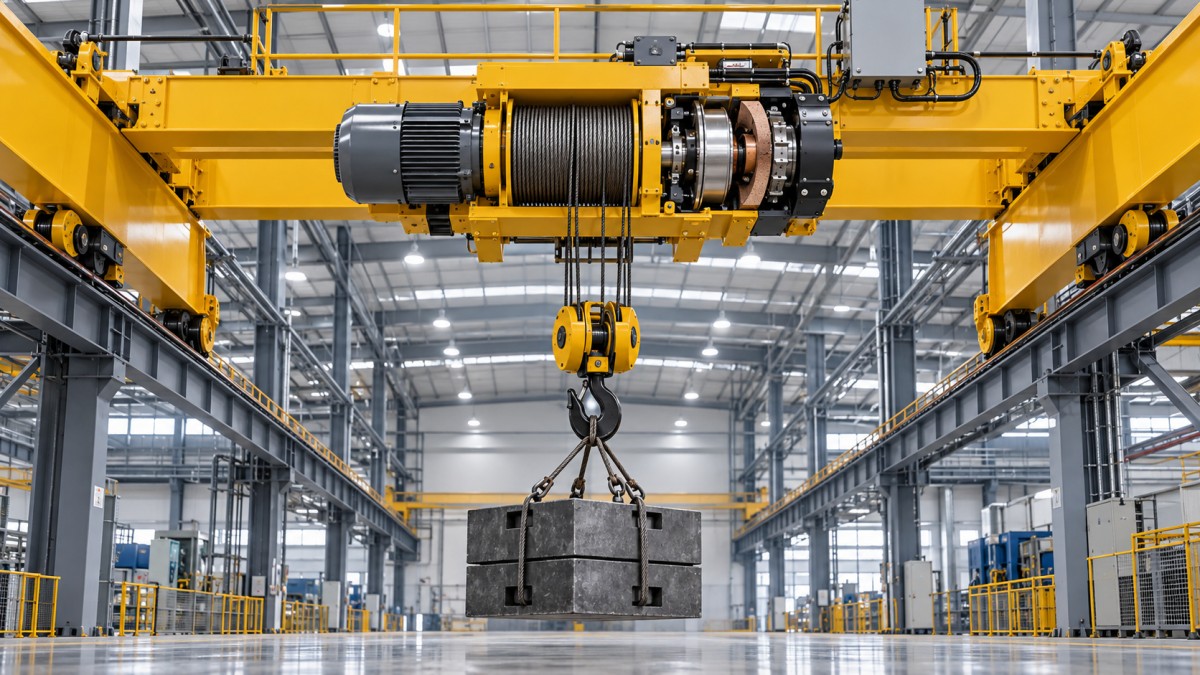
The most serious functional warning is load drift after a commanded stop or after power removal. Any unexplained hook movement with a suspended load requires immediate assessment under the site’s safe-work procedures. Do not use a production lift as a diagnostic experiment. A controlled test plan, appropriate exclusion zone, qualified personnel, and the manufacturer’s instructions are essential. The question is not merely whether the brake eventually holds; it is whether it holds consistently under the operating conditions for which the crane is being used.
What inspection findings actually matter?
Brake inspection should connect mechanical condition with operating behavior. A useful inspection record includes the brake gap or clearance specified for that model, friction-material condition, spring condition, pivot movement, fastener security, coil and wiring observations, signs of oil or grease, and the result of functional testing. If the crane uses a variable-frequency drive, the review should also include drive braking settings and any programmed deceleration behavior. Mechanical brake wear can be accelerated when drive settings cause the brake to set before motor torque has been removed correctly.
One recurring mistake is treating brake adjustment as a performance test. Adjustment establishes the required working clearance or torque condition; it does not prove the brake will behave correctly in service. Functional testing, carried out in accordance with the equipment instructions and site procedures, is what confirms that the crane stops and holds as expected.
Do not confuse brake wear with a broader crane-control problem
A brake often becomes the visible suspect because it is the final mechanical element in the stopping sequence. Yet a deeper fault may sit elsewhere. Low or unstable control voltage can prevent full brake release. A worn coupling or gearbox problem can create shock loading that looks like harsh brake engagement. Incorrect motor brake timing can cause repeated friction heating. On older cranes, accumulated dust, corrosion, and hardened lubricant around linkages can make an otherwise serviceable brake sluggish.
For that reason, replacement work should include a brief cause-and-effect review. Ask what changed before the brake began acting differently. Was the crane moved to a heavier duty task? Has the load pattern changed from occasional lifts to frequent short cycles? Did the site install a new VFD, modify pendant controls, or alter supply conditions? Has oil appeared near the brake from a gearbox seal? These questions often prevent the expensive frustration of replacing a brake assembly only to see the same symptoms return.
This systems view is increasingly relevant as lifting equipment becomes more connected. Fleet monitoring, condition records, and digital maintenance logs can show whether a crane has experienced more starts, stops, overload events, or temperature-related alarms than usual. Data does not replace a physical brake inspection, but it can help maintenance planners target the cranes that deserve attention before a scheduled outage becomes an unplanned one.
Replacement planning: avoid the cheapest short-term decision
When a brake is near its service limit, it is usually better to schedule replacement during a planned maintenance window than wait for a failed inspection, persistent drift complaint, or production stoppage. This is particularly true for cranes supporting a single process line, a furnace service area, a loading bay, or a maintenance shop where there is no practical backup lifting method.
The correct scope depends on the brake design. Some units are intended to be rebuilt with approved friction parts and wear items; others are more sensibly replaced as a complete assembly. Cost should not be viewed only as the price of a lining set versus a new brake. Consider technician time, access difficulty, the condition of mating surfaces, lead time for parts, the risk of repeat shutdown, and whether the original fault has been identified. A low-cost repair is not economical if it requires another outage a few weeks later.
Use parts that match the crane manufacturer’s specifications or are explicitly approved for the application. A brake is not a generic consumable simply because the dimensions appear similar. Torque characteristics, coil voltage, spring force, mounting arrangement, and friction material can all matter. This is especially important where cranes have been modified over time or where documentation is incomplete. In those cases, verify the brake nameplate, hoist model, motor data, drawings, and prior maintenance history before ordering components.
A practical decision rule for maintenance teams
Replace the overhead crane brake, or the affected wear components, when inspection shows that the manufacturer’s wear or adjustment limits have been reached; when friction surfaces are damaged or contaminated; when the brake cannot reliably hold or release; or when recurring heat and adjustment issues show that the assembly is no longer stable in service. If the crane’s behavior has changed but the brake itself appears sound, investigate the drive, power supply, linkage, gearbox, and control timing before condemning the brake.
For plant managers and safety teams, the useful question is not “Can this brake run a little longer?” It is “Can we demonstrate that it will stop and hold predictably until the next planned maintenance opportunity?” If the answer is uncertain, the crane should not be kept in service merely because the lining has not completely worn away.
Across the material-handling sector, from conventional wire-rope hoists to automated lifting systems, brake maintenance remains a basic but unforgiving discipline. Careful inspection records, qualified troubleshooting, correct parts identification, and attention to the whole braking sequence will do more for crane uptime than repeatedly adjusting a problem that has already reached its replacement point.
Recommended News
 Oct 04, 2026When Should an Overhead Crane Brake Be Replaced?When should an overhead crane brake be replaced? Learn key warning signs, inspection priorities, and practical replacement guidance to improve safety and uptime.
 Aug 14, 2026China Tightens Export Checks on Lifting Equipment, Including Double Girder Overhead CranesChina tightens export checks on double girder overhead cranes and other lifting equipment. Learn what exporters must do to avoid customs rejection and delays.
 Aug 10, 2026How to Specify Steel Mill Crane Systems for Heat, Load, and Duty CycleSteel mill crane systems specification guide for heat, load, and duty cycle. Learn how to reduce downtime, improve safety, and choose the right crane for demanding mill operations.
 Aug 10, 2026EN 13001-3:2026 Tightens Wind Stability TestsEN 13001-3:2026 tightens wind stability tests for EU-bound cranes, requiring simulation plus physical verification. Learn how CE certification, exports, and delivery timelines may be affected.
 Jul 27, 2026EU Updates EN 13001-3-1:2026 for Crane Wind StabilityEN 13001-3-1:2026 updates crane wind stability rules for Double Girder Overhead Cranes in the EU. Learn the new testing, CE compliance, and delivery impacts before 2027.
 Jul 07, 2026Precision Lifting Crane: Key Factors for Accurate Load PositioningPrecision lifting crane performance depends on anti-sway control, rigid structure, VFD tuning, and sensors. Learn what drives accurate load positioning before you buy.
 Jun 21, 2026Overhead Cranes for Workshops: Key Specs Before You ChooseOverhead cranes for workshops: compare capacity, span, headroom, duty class, and safety features to choose the right system, reduce downtime, and improve workflow ROI.
 Jun 20, 2026Heavy Component Hoisting Solutions for Tight Plant InstallationsHeavy component hoisting solutions for tight plant installations improve safety, precision, and shutdown control. Discover smart lifting strategies for confined industrial projects.
 Jun 17, 2026BOJ Rate Hike Lifts Appetite for Premium Equipment ImportsBOJ rate hike boosts Japan’s interest in premium equipment imports. See how a stronger yen may lift demand for Double Girder Overhead Cranes, VNA articulated trucks, and Li-ion forklifts.
 Jun 13, 2026China Extends Smart Pre-Clearance to Overhead CranesChina extends smart pre-clearance to overhead cranes, cutting port inspection time to 4 hours for eligible AEO exporters. Learn the new document requirements and shipment planning impact.
 Jun 11, 2026China Customs Tightens Export Declarations for CranesChina Customs tightens export declarations for cranes from June 30, 2026. Learn how Double Girder Overhead Cranes and RMG Gantry Cranes may face stricter filing rules.
 Jun 10, 2026Steel Mill Overhead Cranes: Key Duty Class and Heat Protection ChecksSteel mill overhead cranes demand more than rated capacity. Learn how duty class and heat protection checks improve safety, uptime, and long-term performance in harsh steel plant operations.
 May 28, 2026Overhead cranes can cut delays if layout is plannedOverhead cranes cut delays when layout is planned right. Learn how smarter crane zoning, safer load paths, and workflow alignment boost throughput and reduce costly downtime.